I don't know about you, but I rather like Apologetix, that infamous Christian parody band. Ok, I know some you, in fact, loathe them. I'm looking at you, Matt.
But I came across this fan made music video and it was just so topical! It talks about Kings Hezekiah and Josiah, who we previously discussed in 2 Kings. Plus, it contains clips from both and Star Wars and Jingle All the Way, two of life's greatest cinematic pleasures!
Saturday, July 4, 2009

1 Chronicles 1-9
Who wants to reread exactly what they just read all over again? Only different! Chronicles is essentially a repeat of Kings, only from a different perspective. Remember our discussion on the message of Kings? Well, Chronicles has a similar message of hope. But while Kings ended during the grim future of Babylonian exile, Chronicles was written during the post-exilic era, after the Persians had allowed the Israelites to return home.
The unnamed author, usually dubbed the Chronicler (doesn't that sound like an awesome villain from the '60s Batman tv show?), seems to take material from several of the already written, now biblical, texts available to him. He takes this multitude of sources and attempts to combine them into a singular, coherent narrative.*
The Chronicler begins, essentially, with the story thus far. It's nearly as condensed as my own version. Chronicles 1-9 recount the genealogies of, well, lots of people. It specifically goes from Adam, to Noah, to Israel, down to David, legitimizing his kingship and his line of descendants as rulers. But the Chronicler also lays out the multitude of descendants of Noah's sons, Ham, Shem, and Cush, that make up all the nationalities of the ancient Middle East. In case you were wondering, descendants from Shem are Semitic people, which include the line of Israel. Hence, bigotry against Hebrews (Jews) is called anti-Semitism. Actually, Semites include a much wider spectrum of peoples, but Jews seem to be singled out.
The Chronicler seems to have gathered these genealogies from previous books, such as Genesis, and streamlined them into a more coherent succession to serve his purpose. While the vast majority of this section is lists of descendants, there are little blurbs about certain individuals scattered throughout. It's here we find the brief "Prayer of Jabez" that was capitalized on. The whole verse is only 2 verses long, yet it was exploited for books, videos, and a slew of merchandise! As for me, I plan to make my fortune off of exploiting 2 Kings 18:27.**
This section ends with the Chronicler reiterating 2 Kings' message that God exiled Judah to Babylon because of its unfaithfulness. He then includes genealogies of some of the people that have now returned from exile back to Judah. Next up: Back to Saul!
*This would, obviously, bring into question the claim of divine dictation, the notion that God deliberately and distinctly dictated every single word of the Bible to the given authors. When examined critically, though, this notion doesn't hold. The many variations, alterations, and discrepancies throughout the Bible would imply a forgetful or schizophrenic singular author.
This doesn't mean that God was wholly absent from the compilation of his Book. God certainly could have divinely nudged authors in a certain direction. This would actually seem likely considering the coherence of underlying themes written over the expanse of such a long period of time.
This may seem unsettling, for some of you may have been raised to believe in divine dictation, as I was. Certainly, divine dictation would demand the fullest attention to a pastor preaching scripture, for it is the literal, exact words of the Lord, inerrant in everything. Conceding to the craftsmanship of human authorship, though, doesn't make the Bible any less true. Like I said before, God easily could have had a hand in the compilation of these texts. For me, understanding the human aspect makes the Bible far more approachable, especially when one considers the circumstances of its composition and emphasizes with the target audience of the period.
CIE. Context Is Everything. Without it, people can just excise willy nilly any message they want from the Bible. And they do. Just look at all the televangelists out there.
**"But the Rabshakeh said to them, 'Has my master sent me to speak these words to your master and to you, and not to the people sitting on the wall, who are doomed with you to eat their own dung and drink their own urine?'"
The unnamed author, usually dubbed the Chronicler (doesn't that sound like an awesome villain from the '60s Batman tv show?), seems to take material from several of the already written, now biblical, texts available to him. He takes this multitude of sources and attempts to combine them into a singular, coherent narrative.*
The Chronicler begins, essentially, with the story thus far. It's nearly as condensed as my own version. Chronicles 1-9 recount the genealogies of, well, lots of people. It specifically goes from Adam, to Noah, to Israel, down to David, legitimizing his kingship and his line of descendants as rulers. But the Chronicler also lays out the multitude of descendants of Noah's sons, Ham, Shem, and Cush, that make up all the nationalities of the ancient Middle East. In case you were wondering, descendants from Shem are Semitic people, which include the line of Israel. Hence, bigotry against Hebrews (Jews) is called anti-Semitism. Actually, Semites include a much wider spectrum of peoples, but Jews seem to be singled out.
The Chronicler seems to have gathered these genealogies from previous books, such as Genesis, and streamlined them into a more coherent succession to serve his purpose. While the vast majority of this section is lists of descendants, there are little blurbs about certain individuals scattered throughout. It's here we find the brief "Prayer of Jabez" that was capitalized on. The whole verse is only 2 verses long, yet it was exploited for books, videos, and a slew of merchandise! As for me, I plan to make my fortune off of exploiting 2 Kings 18:27.**
This section ends with the Chronicler reiterating 2 Kings' message that God exiled Judah to Babylon because of its unfaithfulness. He then includes genealogies of some of the people that have now returned from exile back to Judah. Next up: Back to Saul!
*This would, obviously, bring into question the claim of divine dictation, the notion that God deliberately and distinctly dictated every single word of the Bible to the given authors. When examined critically, though, this notion doesn't hold. The many variations, alterations, and discrepancies throughout the Bible would imply a forgetful or schizophrenic singular author.
This doesn't mean that God was wholly absent from the compilation of his Book. God certainly could have divinely nudged authors in a certain direction. This would actually seem likely considering the coherence of underlying themes written over the expanse of such a long period of time.
This may seem unsettling, for some of you may have been raised to believe in divine dictation, as I was. Certainly, divine dictation would demand the fullest attention to a pastor preaching scripture, for it is the literal, exact words of the Lord, inerrant in everything. Conceding to the craftsmanship of human authorship, though, doesn't make the Bible any less true. Like I said before, God easily could have had a hand in the compilation of these texts. For me, understanding the human aspect makes the Bible far more approachable, especially when one considers the circumstances of its composition and emphasizes with the target audience of the period.
CIE. Context Is Everything. Without it, people can just excise willy nilly any message they want from the Bible. And they do. Just look at all the televangelists out there.
**"But the Rabshakeh said to them, 'Has my master sent me to speak these words to your master and to you, and not to the people sitting on the wall, who are doomed with you to eat their own dung and drink their own urine?'"
Thursday, July 2, 2009
Michael and BEARS!
My brother (check out his blog here) just informed me that there is a Michael W. Smith song, Love Me Good, that contains the lyrics "you never know when you might be attacked by the BEARS."
Has Michael been mocking bald people?
I find the video below kind of disturbing for reasons I can't quite place my finger on.
Has Michael been mocking bald people?
I find the video below kind of disturbing for reasons I can't quite place my finger on.
2 Kings 21-25
Let's start with a brief note on the structure of Kings, shall we? The histories of these kings recorded within are mostly brief, usually detailing only any wars or other specific events they were involved in. Instead of the broader history, Kings seems intent on relating whether each king followed the Lord or strayed and worshiped idols and other gods (the majority of them did not follow the Lord). This is reiterated by the frequent advice to the reader to look in the (now lost) Annals of the Kings of Israel and Judah for more detailed accounts of the actions of these kings. Kings is not an objective history, but a theological narrative with a specific agenda and message. We'll discuss this more as we reach the endgame of 2 Kings.
This portion of our story starts off with the reign of Manasseh, Hezekiah's son (who's now, obviously, deceased). Manasseh was the opposite of his papa and did all that was evil in the sight of the Lord, including dealing with wizards (and I bet they weren't good wizards, like Gandalf, but more the evil wizard type, like Saruman. Actually, I think as far as God is concerned, all wizards are evil. Tough luck, Gandalf). Because of Manasseh's rampant idolatry, God becomes completely fed up and vows to wipe out Judah. From this vow, we now know how God washes his dishes (wiping them and turning them upside down).
Evil Manasseh dies and his son Amon replaces him. Amon was also evil (typical), so a group of conspirators killed him. But then the rest of the folk killed the conspirators and made Amon's son Josiah king. Now, Josiah was one of those rare, godly kings and oversaw repairs on the Temple. During these repairs, the high priest Hilkiah discovered a long lost book of the law hidden away in the Temple. After reading the book, Josiah tore his clothes (a sign of great grief) because of how much they had apparently been doing wrong all these years.
This book was likely a portion of Deuteronomy which had apparently been lost and forgotten. This portion contained, among other things, the instructions for the Passover festival, which had not been observed since the time of the judges!* Josiah gathered the people, read the lost book to them, went on a rampage destroying and desecrating all foreign idols and altars, and held the Passover.
However, all this returning to the ways of the Lord did not dissuade God from his previous wrath incited by Manasseh. Josiah later met up with Pharaoh Neco of Egypt, who killed Josiah. His son Jehoahaz became king, but Neco imprisoned him and places Josiah's other son, Eliakim, as king. Of course, to make things more fun and confusing, Eliakim's name is changed to Jehoiakim.
Enter the CHALDEANS!**
King Nebuchadnezzar (yes, this is where the namesake of Morpheus' ship in the Matrix comes from) descends upon Judah and raises havoc. Jehoiakim dies and his son Jehoiachin takes his place. Nebuchadnezzar instigates a siege against Jerusalem, causing Jehoiachin to surrender. He's exiled to Babylon and his uncle, Mattaniah (renamed Zedekiah) is appointed the new ruler by Nebuchadnezzar.

But Zedekiah rebels and another siege of Jerusalem takes place. Zedekiah tries to flee, but is captured and forced to watch the slaughter of all his children. His eyes are then gouged out and he's taken away to Babylon. Nebuchadnezzar's captain, Nebuzaradan, proceeds to utterly destroy Jerusalem, burning down all the houses, palaces, and the Temple. Another guy, Gedaliah was appointed governor of all those who remained in Judah. But then he was killed and all the people who were left fled to Egypt for they were utterly afraid of the Chaldeans.
The book of 2 Kings ends with a short footnote that the later king of Babylon, Evil-merodach, releases Jehoiachin (the king that initially surrendered at Jerusalem) from prison, befriends him, and has him dine with the king every day.
So, what about that rambling paragraph I started this post with? The author of 2 Kings makes it bluntly clear, several times, that it was because of Manasseh's sins that God sent the Chaldeans to wipe out Judah and remove all the people to Babylon. So? What's the big deal about that? Well, the big deal is that it was during this exile that these texts were probably compiled and composed, meaning we should probably try to understand what those Hebrews in exile would take to heart from this. The main thrust of it being, because they sinned and disobeyed God, God took them from their homeland. Nebuchadnezzar and the Chaldeans at large aren't in control. They are mere tools of the Lord. God is in control and orchestrated this to happen.
Again, so what? Well, if the Chaldeans were in control, then all hope would have been lost. But if the Lord is in control, then there's still hope. If Judah's sin caused this calamity, then maybe if the people repent of their sin, change their ways, and follow God once again, then the Lord's favor will return and he'll free his people (as is the trend of the Deuteronomistic History, which may also have been part of the book that Josiah found). So while it may at first seem that 2 Kings ends with the dismal horror of exile, it actually ends with a message of hope, particularly for those still in exile who would have read or heard this narrative.
A rather impressive literary device, is it not?
*The judges ruled over the tribes of Israel before the institution of the monarchy began with King Saul. Saul ruled about 400 years before Josiah, so the last time the Passover was observed was well over 400 years prior!
**Or Babylonians, if you prefer.
This portion of our story starts off with the reign of Manasseh, Hezekiah's son (who's now, obviously, deceased). Manasseh was the opposite of his papa and did all that was evil in the sight of the Lord, including dealing with wizards (and I bet they weren't good wizards, like Gandalf, but more the evil wizard type, like Saruman. Actually, I think as far as God is concerned, all wizards are evil. Tough luck, Gandalf). Because of Manasseh's rampant idolatry, God becomes completely fed up and vows to wipe out Judah. From this vow, we now know how God washes his dishes (wiping them and turning them upside down).
Evil Manasseh dies and his son Amon replaces him. Amon was also evil (typical), so a group of conspirators killed him. But then the rest of the folk killed the conspirators and made Amon's son Josiah king. Now, Josiah was one of those rare, godly kings and oversaw repairs on the Temple. During these repairs, the high priest Hilkiah discovered a long lost book of the law hidden away in the Temple. After reading the book, Josiah tore his clothes (a sign of great grief) because of how much they had apparently been doing wrong all these years.
This book was likely a portion of Deuteronomy which had apparently been lost and forgotten. This portion contained, among other things, the instructions for the Passover festival, which had not been observed since the time of the judges!* Josiah gathered the people, read the lost book to them, went on a rampage destroying and desecrating all foreign idols and altars, and held the Passover.
However, all this returning to the ways of the Lord did not dissuade God from his previous wrath incited by Manasseh. Josiah later met up with Pharaoh Neco of Egypt, who killed Josiah. His son Jehoahaz became king, but Neco imprisoned him and places Josiah's other son, Eliakim, as king. Of course, to make things more fun and confusing, Eliakim's name is changed to Jehoiakim.
Enter the CHALDEANS!**
King Nebuchadnezzar (yes, this is where the namesake of Morpheus' ship in the Matrix comes from) descends upon Judah and raises havoc. Jehoiakim dies and his son Jehoiachin takes his place. Nebuchadnezzar instigates a siege against Jerusalem, causing Jehoiachin to surrender. He's exiled to Babylon and his uncle, Mattaniah (renamed Zedekiah) is appointed the new ruler by Nebuchadnezzar.

But Zedekiah rebels and another siege of Jerusalem takes place. Zedekiah tries to flee, but is captured and forced to watch the slaughter of all his children. His eyes are then gouged out and he's taken away to Babylon. Nebuchadnezzar's captain, Nebuzaradan, proceeds to utterly destroy Jerusalem, burning down all the houses, palaces, and the Temple. Another guy, Gedaliah was appointed governor of all those who remained in Judah. But then he was killed and all the people who were left fled to Egypt for they were utterly afraid of the Chaldeans.
The book of 2 Kings ends with a short footnote that the later king of Babylon, Evil-merodach, releases Jehoiachin (the king that initially surrendered at Jerusalem) from prison, befriends him, and has him dine with the king every day.
So, what about that rambling paragraph I started this post with? The author of 2 Kings makes it bluntly clear, several times, that it was because of Manasseh's sins that God sent the Chaldeans to wipe out Judah and remove all the people to Babylon. So? What's the big deal about that? Well, the big deal is that it was during this exile that these texts were probably compiled and composed, meaning we should probably try to understand what those Hebrews in exile would take to heart from this. The main thrust of it being, because they sinned and disobeyed God, God took them from their homeland. Nebuchadnezzar and the Chaldeans at large aren't in control. They are mere tools of the Lord. God is in control and orchestrated this to happen.
Again, so what? Well, if the Chaldeans were in control, then all hope would have been lost. But if the Lord is in control, then there's still hope. If Judah's sin caused this calamity, then maybe if the people repent of their sin, change their ways, and follow God once again, then the Lord's favor will return and he'll free his people (as is the trend of the Deuteronomistic History, which may also have been part of the book that Josiah found). So while it may at first seem that 2 Kings ends with the dismal horror of exile, it actually ends with a message of hope, particularly for those still in exile who would have read or heard this narrative.
A rather impressive literary device, is it not?
*The judges ruled over the tribes of Israel before the institution of the monarchy began with King Saul. Saul ruled about 400 years before Josiah, so the last time the Passover was observed was well over 400 years prior!
**Or Babylonians, if you prefer.
Wednesday, July 1, 2009
2 Kings 16-20
Behold the might of the ASSYRIAN EMPIRE! Duh duh duh!
Jotham's son, King Ahaz of of Judah was an evil bugger that did not follow the Lord. He worshiped other gods, which included the sacrificing of his son with fire. This was probably an act of worship to the god Molech. Aram and Israel team up against Judah, so Ahaz seeks the help of Assyria. The great Assyrian Empire enters the fray and wipes out Aram. Ahaz goes back to his streak of idolatry by building a new altar in the Temple.
Up north in Israel, Hoshea is king and being bullied by King Shalmaneser of Assyria. Hoshea tries to appease him via tribute, but Shalmaneser invades, conquers, and exiles the rest of the populace to Assyria. Israel is then repopulated with foreigners. But they worship their own gods, so God sends lions to attack them! Not quite BEARS, but it'll do. So the King of Assyria sends an Israelite priest back to teach the folks how to worship the Lord. They don't do this exclusively, though, but just add him to their collective of deities to worship.
Back in Judah, Ahaz dies and his son Hezekiah takes over. Hezekiah is the first truly, all out, godly King since David. He removes all of the idols and idolatrous altars throughout Judah, reestablishing monotheism in the land. Now Assyria invades Judah and is knocking on Hezekiah's door. Sennacherib, the current king of Assyria sends his servants to the gates of Jerusalem to get Hezekiah and Judah to surrender. But Hezekiah is defiant! Way to be, Hezekiah, way to be.
The Assyrian servants loudly taunt and exclaim the horrors that should befall the people if Judah doesn't surrender. Hezekiah's men at the gate beg these Assyrian ambassadors to speak in another language, so any nearby citizens of Jerusalem won't hear the threatening things being said. The Assyrians respond, still in Hebrew, to the citizens listening in that they will be forced to "eat their own dung" and "drink their own urine" (18:27)! Seriously, I don't think literature gets any better than this! And I'd bet that, like today, such an insult would be vocalized in a much more derogatory fashion than as it's recorded here.
Hezekiah seeks out the prophet Isaiah for help. Isaiah says all will be well and not to worry. The Assyrians threaten ag ain, so Hezekiah goes to the Temple to pray for victory. Isaiah confirms that God has heard Hezekiah's prayer and all will be well. That night an angel comes down and reportedly kills 185,000 Assyrian troops*, which causes the rest of the army to pack up and go home the next day.
Hezekiah later falls ill and prays to be healed. Isaiah confirms that the king will be healed. But Hezekiah wants to know if it will be temporary or long lasting. If it's to be permanent, an advancing shadow should recede. Isaiah says this will happen and, at his word, the shadow goes backwards, implying that the Lord has control over the position of the sun (or can reverse the rotation of the earth. Or maybe it was just a cloud caught in a funky wind. Whatever, the shadow went the other way, deal with it!).
Then some Babylonians come on good terms and check out Hezekiah's digs. Isaiah later reveals that these Babylonians will be the downfall of Judah after Hezekiah is gone. The king responds that this is fine. Why should he care what comes later as long as there is peace during his reign? Hezekiah's a dick.
* The Bible has a track record of it's numbers and tallies not matching up to what we interpret them as today. Some have suggested that words like "thousand" may have held a different numerical value other than 1000. Sennacherib of Assyria usually kept detailed records of his military excursions, though they conspicuously say nothing about the sudden abandonment of the siege of Jerusalem. As for the death of so many men, some suggest the "angel of the Lord" could have come in the form of disease or plague. Or vampires.
Jotham's son, King Ahaz of of Judah was an evil bugger that did not follow the Lord. He worshiped other gods, which included the sacrificing of his son with fire. This was probably an act of worship to the god Molech. Aram and Israel team up against Judah, so Ahaz seeks the help of Assyria. The great Assyrian Empire enters the fray and wipes out Aram. Ahaz goes back to his streak of idolatry by building a new altar in the Temple.
Up north in Israel, Hoshea is king and being bullied by King Shalmaneser of Assyria. Hoshea tries to appease him via tribute, but Shalmaneser invades, conquers, and exiles the rest of the populace to Assyria. Israel is then repopulated with foreigners. But they worship their own gods, so God sends lions to attack them! Not quite BEARS, but it'll do. So the King of Assyria sends an Israelite priest back to teach the folks how to worship the Lord. They don't do this exclusively, though, but just add him to their collective of deities to worship.
Back in Judah, Ahaz dies and his son Hezekiah takes over. Hezekiah is the first truly, all out, godly King since David. He removes all of the idols and idolatrous altars throughout Judah, reestablishing monotheism in the land. Now Assyria invades Judah and is knocking on Hezekiah's door. Sennacherib, the current king of Assyria sends his servants to the gates of Jerusalem to get Hezekiah and Judah to surrender. But Hezekiah is defiant! Way to be, Hezekiah, way to be.
The Assyrian servants loudly taunt and exclaim the horrors that should befall the people if Judah doesn't surrender. Hezekiah's men at the gate beg these Assyrian ambassadors to speak in another language, so any nearby citizens of Jerusalem won't hear the threatening things being said. The Assyrians respond, still in Hebrew, to the citizens listening in that they will be forced to "eat their own dung" and "drink their own urine" (18:27)! Seriously, I don't think literature gets any better than this! And I'd bet that, like today, such an insult would be vocalized in a much more derogatory fashion than as it's recorded here.
Enter Isaiah!
Hezekiah seeks out the prophet Isaiah for help. Isaiah says all will be well and not to worry. The Assyrians threaten ag
 ain, so Hezekiah goes to the Temple to pray for victory. Isaiah confirms that God has heard Hezekiah's prayer and all will be well. That night an angel comes down and reportedly kills 185,000 Assyrian troops*, which causes the rest of the army to pack up and go home the next day.
Hezekiah later falls ill and prays to be healed. Isaiah confirms that the king will be healed. But Hezekiah wants to know if it will be temporary or long lasting. If it's to be permanent, an advancing shadow should recede. Isaiah says this will happen and, at his word, the shadow goes backwards, implying that the Lord has control over the position of the sun (or can reverse the rotation of the earth. Or maybe it was just a cloud caught in a funky wind. Whatever, the shadow went the other way, deal with it!).
Then some Babylonians come on good terms and check out Hezekiah's digs. Isaiah later reveals that these Babylonians will be the downfall of Judah after Hezekiah is gone. The king responds that this is fine. Why should he care what comes later as long as there is peace during his reign? Hezekiah's a dick.
* The Bible has a track record of it's numbers and tallies not matching up to what we interpret them as today. Some have suggested that words like "thousand" may have held a different numerical value other than 1000. Sennacherib of Assyria usually kept detailed records of his military excursions, though they conspicuously say nothing about the sudden abandonment of the siege of Jerusalem. As for the death of so many men, some suggest the "angel of the Lord" could have come in the form of disease or plague. Or vampires.
2 Kings 11-15
Man, so far 2 Kings has been a dry streak when it comes to prostitutes. But the violence and political intrigue continues!
Remember a couple chapters back how Jehu killed Jehoram of Israel and Ahaziah of Judah? Well, Ahaziah's mother, Athaliah, quickly kills the rest of the Judean royal family so that she can rule. But Joash*, the king's infant son, was hidden in a bedroom with his nurse. And there he stayed for six years!

Eventually, a priest named Jehoiada arranges for Joash to be transported to the Temple in secret and anoints him king of Judah. Athaliah is outraged by this, but then is quickly taken away by guards and executed. But, was this really such a great idea, Jehoiada? Did you think this all the way through? You just crowned a 7 year-old as king. He's only SEVEN (or in Fincher terms, Se7en)! And so far he's spent all of those years secluded in a closet! He probably doesn't have the best grasp of domestic and foreign issues.
Oh, but I see, Jehoiada acted like a puppet master, instructing Joash on how he should rule. However, later in life, he butts heads with the priest over the issue of repairing the Temple. The priests don't want to spend the money, so Joash gets more personally involved with overseeing the allocation of funds. Since, by this time, it has been at least a century since Solomon first built the Temple, it's understandable that the structure would be in need of some repairs. Good thinking, Joash.
Hazael of Aram makes another aggressive appearance, but Joash pays him off and the Aramean army leaves without incident. But then Joash's servants rebel and kill him. His son Amaziah assumes the throne. Amaziah. Now that's an amazing name!
Meanwhile, Jehu of Israel dies and his son Jehoahaz becomes king. More wars with Aram occur, and then he dies and is followed by his son Joash.** During his reign Elisha becomes seriously ill, so Joash has a pow-wow with the prophet. Elisha tells the king to do a bunch of funny stuff with a bow and arrow to symbolize what Israel will do to Aram. I'm not sure Elisha was all there at this point. He yells at Joash for striking the ground with arrows three times instead of five or six. Joash just better be glad Elisha didn't call some BEARS over.
So, Elisha dies and they bury the bald prophet. During an unrelated funeral, some passing marauders throw the deceased into Elisha's grave. When the corpse touched the bones of Elisha, it came back to life! So, even when he's dead, Elisha can bring people back to life? Maybe he could've tried to bring himself back to life, too? I'm sure there were many more bratty kids in those days that needed to be eaten by BEARS!
Back to Judah. Amaziah becomes king and immediately kills the servants that killed his father Joash (you figure out which Joash it is this time. This is giving me a headache). He had some victories over the nation of Edom, got high on hubris, and challanged Israel to some battling. King Joash (gah!) dismissed the notion, implying he'd squash Judah and Amaziah should just go away. But Amaziah pressed the issue, and summarily had his butt handed to him by Israel. Then folks conspired against Amaziah, killed him, and made his sixteen year-old son Azariah*** king. Guess Amaziah wasn't all that amazing, was he? Zing! Anyway, Azariah was stricken with leprosy and his son Jotham ruled in his stead until Azariah died and Jotham became king for real.
Israel time. Joash (gah!) dies and his son Jeroboam (double gah!) becomes king. Okay, yet again, this is a different Jeroboam than we've had previously, but they were both kings of the northern kingdom of Israel. So we'll call this guy Jeroboam II (Jerry II). Interesting tidbit: during the time of Jerry II we get the prophets Amos, Hosea, and Jonah, though only Jonah is briefly mentioned. Jerry II dies and the crown passes to his son Zechariah.
More political intrigue! Zechariah rules for six months before he's killed by a conspiracy led by Shallum. But he only reigns for a single month until another dude, Menahem, kills him! Menahem becomes king and attacks the town of Tiphsah, resorting to such savageries as ripping "open all the pregnant women in it" (15:16). Menahem eventually dies and is followed by his son Pekahiah. But a captain, Pekah, launches a conspiracy and kills Pekahiah and becomes king. Then the Assyrians attack! A large chunk of the population is captured and exiled to Assyria. Pekah is then killed by Hoshea, who assumes the throne. Israel is a very politically unstable place.
Confused yet?
*Another way to spell Joash is "Jehoash." The biblical authors use both spellings interchangeably. Way to make this even more confusing!
**Are you kidding me?! I used to think biblical names were all unique and weird, but when you actually read through the thing you find they're as common as Bob, John, or Bort. And NO! this isn't the same Joash we just covered, it's a different one. This is Joash of Israel, not Joash of Judah. However, the same note about the spelling still applies. Wonderful.
***Azariah is also called Uzziah and, of course, the two names are used interchangeably. If you're not aware of this, the story gets even more confusing, if you can believe that!
Remember a couple chapters back how Jehu killed Jehoram of Israel and Ahaziah of Judah? Well, Ahaziah's mother, Athaliah, quickly kills the rest of the Judean royal family so that she can rule. But Joash*, the king's infant son, was hidden in a bedroom with his nurse. And there he stayed for six years!

Eventually, a priest named Jehoiada arranges for Joash to be transported to the Temple in secret and anoints him king of Judah. Athaliah is outraged by this, but then is quickly taken away by guards and executed. But, was this really such a great idea, Jehoiada? Did you think this all the way through? You just crowned a 7 year-old as king. He's only SEVEN (or in Fincher terms, Se7en)! And so far he's spent all of those years secluded in a closet! He probably doesn't have the best grasp of domestic and foreign issues.
Oh, but I see, Jehoiada acted like a puppet master, instructing Joash on how he should rule. However, later in life, he butts heads with the priest over the issue of repairing the Temple. The priests don't want to spend the money, so Joash gets more personally involved with overseeing the allocation of funds. Since, by this time, it has been at least a century since Solomon first built the Temple, it's understandable that the structure would be in need of some repairs. Good thinking, Joash.
Hazael of Aram makes another aggressive appearance, but Joash pays him off and the Aramean army leaves without incident. But then Joash's servants rebel and kill him. His son Amaziah assumes the throne. Amaziah. Now that's an amazing name!
Meanwhile, Jehu of Israel dies and his son Jehoahaz becomes king. More wars with Aram occur, and then he dies and is followed by his son Joash.** During his reign Elisha becomes seriously ill, so Joash has a pow-wow with the prophet. Elisha tells the king to do a bunch of funny stuff with a bow and arrow to symbolize what Israel will do to Aram. I'm not sure Elisha was all there at this point. He yells at Joash for striking the ground with arrows three times instead of five or six. Joash just better be glad Elisha didn't call some BEARS over.
So, Elisha dies and they bury the bald prophet. During an unrelated funeral, some passing marauders throw the deceased into Elisha's grave. When the corpse touched the bones of Elisha, it came back to life! So, even when he's dead, Elisha can bring people back to life? Maybe he could've tried to bring himself back to life, too? I'm sure there were many more bratty kids in those days that needed to be eaten by BEARS!
Back to Judah. Amaziah becomes king and immediately kills the servants that killed his father Joash (you figure out which Joash it is this time. This is giving me a headache). He had some victories over the nation of Edom, got high on hubris, and challanged Israel to some battling. King Joash (gah!) dismissed the notion, implying he'd squash Judah and Amaziah should just go away. But Amaziah pressed the issue, and summarily had his butt handed to him by Israel. Then folks conspired against Amaziah, killed him, and made his sixteen year-old son Azariah*** king. Guess Amaziah wasn't all that amazing, was he? Zing! Anyway, Azariah was stricken with leprosy and his son Jotham ruled in his stead until Azariah died and Jotham became king for real.
Israel time. Joash (gah!) dies and his son Jeroboam (double gah!) becomes king. Okay, yet again, this is a different Jeroboam than we've had previously, but they were both kings of the northern kingdom of Israel. So we'll call this guy Jeroboam II (Jerry II). Interesting tidbit: during the time of Jerry II we get the prophets Amos, Hosea, and Jonah, though only Jonah is briefly mentioned. Jerry II dies and the crown passes to his son Zechariah.
More political intrigue! Zechariah rules for six months before he's killed by a conspiracy led by Shallum. But he only reigns for a single month until another dude, Menahem, kills him! Menahem becomes king and attacks the town of Tiphsah, resorting to such savageries as ripping "open all the pregnant women in it" (15:16). Menahem eventually dies and is followed by his son Pekahiah. But a captain, Pekah, launches a conspiracy and kills Pekahiah and becomes king. Then the Assyrians attack! A large chunk of the population is captured and exiled to Assyria. Pekah is then killed by Hoshea, who assumes the throne. Israel is a very politically unstable place.
Confused yet?
*Another way to spell Joash is "Jehoash." The biblical authors use both spellings interchangeably. Way to make this even more confusing!
**Are you kidding me?! I used to think biblical names were all unique and weird, but when you actually read through the thing you find they're as common as Bob, John, or Bort. And NO! this isn't the same Joash we just covered, it's a different one. This is Joash of Israel, not Joash of Judah. However, the same note about the spelling still applies. Wonderful.
***Azariah is also called Uzziah and, of course, the two names are used interchangeably. If you're not aware of this, the story gets even more confusing, if you can believe that!
Tuesday, June 30, 2009
2 Kings 6-10
Still no prostitutes! But what about the violence, you may ask? What about the violence, Smitch? Oh, believe me, there is more violence. 70 severed heads in a basket, anyone?
But before we get to that, Elisha has more miracles to perform, including making iron float in water! Amazing. He also forewarns the king of Israel about the military movements of the Arameans. This perturbs the king of Aram, who dispatches a large squad to capture Elisha. Elisha's servant is scared of the oncoming force until Elisha reveals unto him the heavenly army protecting them.
But when the army arrives, Elisha prays that the Lord will blind it. The soldiers are immediately blind and Elisha tricks them into thinking they're in the wrong spot. The prophet then leads them to the Israelite king in Samaria, where their sight is restored. Instead of slaughtering them, though, Elisha orders that they be fed and allowed to return home. So, an army sent to kill him gets fed and sent home, but kids who call him bald are killed by BEARS!? This Elisha seems to be a finicky cha racter, sometimes.
Later, the ungrateful Arameans return and lay siege to Jehoram's city of Samaria. The siege lasts so long that famine becomes quite severe in Samaria. The citizens are resorting to cannibalism, killing and cooking their own children in order to survive. Jehoram has had enough, says screw it, blames God and his prophet for this mess, and goes to kill Elisha. But Elisha claims the siege and famine will be over soon and, sure enough, it is. The encamped Arameans think they hear a massive army in the night and flee back home, leaving all their gear, supplies, and food behind for the citizens to plunder.
Still later, the same king of Aram is ill and sends his servant Hazael to ask Elisha if he'll recover. Elisha says he will, but then bursts into tears, foreseeing that Hazael himself will become king of Aram and do many treacherous things to Israel. Hearing this news, Hazael returns, smothers the king of Aram and assumes his throne. Hey, Elisha, you ever think that maybe if you hadn't said anything Hazael wouldn't have gotten the idea to become king so strongly implanted in his head? Hmm?
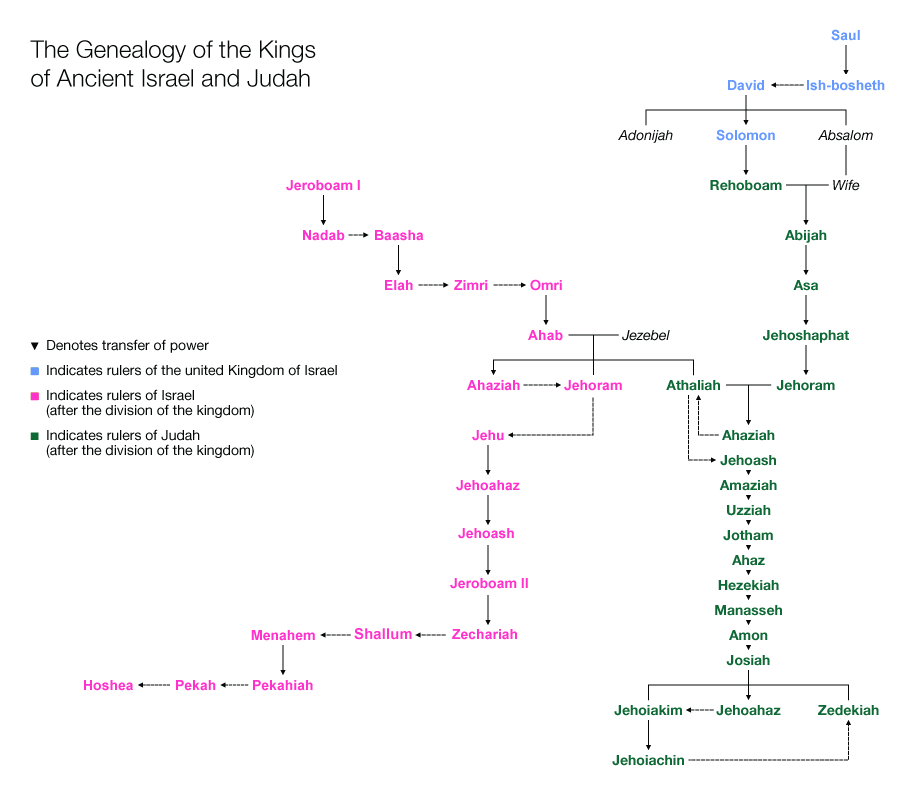
Ok, here the lineage of these kings get kind of confusing. In Israel in the north, we've gone from Ahab, to Ahaziah, to Jehoram, right? Well, in the meantime, in Judah to the south, we've gone from Jehoshaphat, to his son Jehoram (different than Israel's Jehoram), to Ahaziah (different from the now dead Ahaziah of Israel - the dude that fell out of the window). Got it straight? Good. If not, wikipedia has a slightly less confusing flow chart of the kings right here.
So at this time, Jehoram of Israel and Ahaziah of Judah team up to battle Hazael of Aram. Jehoram is wounded and retreats to Jezreel for medical attention. Ahaziah also goes to Jezreel to visit him. Meanwhile, Elisha tells a servant to go to an Israelite army commander by the name of Jehu. In secret, the servant is to anoint Jehu as king of Israel and then RUN AWAY as fast as he freakin' can!

The servant does just this. After much prodding, Jehu eventually tells the other army commanders what just happened, and they all support him as the new king. They head off to Jezreel* and Jehu kills both Jehoram of Israel and Ahaziah of Judah. Entering the town, Jehu heads to the house of Ahab's widow, the evil Jezebel. He calls to her aids to throw her out of the window, and they comply. On impacting the ground, her blood splattered on the wall and some nearby horses, who then proceeded to trample all over her body. Then dogs ate her corpse, leaving only her skull, hands, and feet. Nice.
Then Jehu sent word to Samaria that the king's servants should kill all the remaining descendants of Ahab, 70 in all. He decreed their heads should be sent to him in baskets, and he soon received baskets full of 70 severed heads. Nice one, Jehu. Nice one.
But Jehu wasn't finished with his cleansing slaughter! On his way to Samaria, he came across 42 relatives of Ahaziah of Judah and promptly killed them all. If Elisha was with him he could have just had BEARS maul the lot of them. Jehu made his way to Samaria and called all worshipers of Baal in Israel to the temple of Baal for a grand shindig and sacrifice. Guess what?
*By the way, I now have a new insult to yell at poor drivers. When the treasonous crew approaches Jezreel in the chariots, the sentinel at the gates of the city says it looks like Jehu is coming, "for he drives like a maniac" (9:20). You crazy Jehu! Learn how to drive!
But before we get to that, Elisha has more miracles to perform, including making iron float in water! Amazing. He also forewarns the king of Israel about the military movements of the Arameans. This perturbs the king of Aram, who dispatches a large squad to capture Elisha. Elisha's servant is scared of the oncoming force until Elisha reveals unto him the heavenly army protecting them.
But when the army arrives, Elisha prays that the Lord will blind it. The soldiers are immediately blind and Elisha tricks them into thinking they're in the wrong spot. The prophet then leads them to the Israelite king in Samaria, where their sight is restored. Instead of slaughtering them, though, Elisha orders that they be fed and allowed to return home. So, an army sent to kill him gets fed and sent home, but kids who call him bald are killed by BEARS!? This Elisha seems to be a finicky cha
 racter, sometimes.
Later, the ungrateful Arameans return and lay siege to Jehoram's city of Samaria. The siege lasts so long that famine becomes quite severe in Samaria. The citizens are resorting to cannibalism, killing and cooking their own children in order to survive. Jehoram has had enough, says screw it, blames God and his prophet for this mess, and goes to kill Elisha. But Elisha claims the siege and famine will be over soon and, sure enough, it is. The encamped Arameans think they hear a massive army in the night and flee back home, leaving all their gear, supplies, and food behind for the citizens to plunder.
Still later, the same king of Aram is ill and sends his servant Hazael to ask Elisha if he'll recover. Elisha says he will, but then bursts into tears, foreseeing that Hazael himself will become king of Aram and do many treacherous things to Israel. Hearing this news, Hazael returns, smothers the king of Aram and assumes his throne. Hey, Elisha, you ever think that maybe if you hadn't said anything Hazael wouldn't have gotten the idea to become king so strongly implanted in his head? Hmm?
Ok, here the lineage of these kings get kind of confusing. In Israel in the north, we've gone from Ahab, to Ahaziah, to Jehoram, right? Well, in the meantime, in Judah to the south, we've gone from Jehoshaphat, to his son Jehoram (different than Israel's Jehoram), to Ahaziah (different from the now dead Ahaziah of Israel - the dude that fell out of the window). Got it straight? Good. If not, wikipedia has a slightly less confusing flow chart of the kings right here.
So at this time, Jehoram of Israel and Ahaziah of Judah team up to battle Hazael of Aram. Jehoram is wounded and retreats to Jezreel for medical attention. Ahaziah also goes to Jezreel to visit him. Meanwhile, Elisha tells a servant to go to an Israelite army commander by the name of Jehu. In secret, the servant is to anoint Jehu as king of Israel and then RUN AWAY as fast as he freakin' can!

The servant does just this. After much prodding, Jehu eventually tells the other army commanders what just happened, and they all support him as the new king. They head off to Jezreel* and Jehu kills both Jehoram of Israel and Ahaziah of Judah. Entering the town, Jehu heads to the house of Ahab's widow, the evil Jezebel. He calls to her aids to throw her out of the window, and they comply. On impacting the ground, her blood splattered on the wall and some nearby horses, who then proceeded to trample all over her body. Then dogs ate her corpse, leaving only her skull, hands, and feet. Nice.
Then Jehu sent word to Samaria that the king's servants should kill all the remaining descendants of Ahab, 70 in all. He decreed their heads should be sent to him in baskets, and he soon received baskets full of 70 severed heads. Nice one, Jehu. Nice one.
But Jehu wasn't finished with his cleansing slaughter! On his way to Samaria, he came across 42 relatives of Ahaziah of Judah and promptly killed them all. If Elisha was with him he could have just had BEARS maul the lot of them. Jehu made his way to Samaria and called all worshipers of Baal in Israel to the temple of Baal for a grand shindig and sacrifice. Guess what?
IT'S A TRAP!

With all the Baal worshipers in one place, Jehu kills them all, destroys the temple, and turns it into a latrine! I'm sure he regularly enjoyed taking a leak on the ashes of the temple of Baal. I mean, who wouldn't? Good stuff, Jehu, good stuff.

With all the Baal worshipers in one place, Jehu kills them all, destroys the temple, and turns it into a latrine! I'm sure he regularly enjoyed taking a leak on the ashes of the temple of Baal. I mean, who wouldn't? Good stuff, Jehu, good stuff.
*By the way, I now have a new insult to yell at poor drivers. When the treasonous crew approaches Jezreel in the chariots, the sentinel at the gates of the city says it looks like Jehu is coming, "for he drives like a maniac" (9:20). You crazy Jehu! Learn how to drive!
Subscribe to:
Posts (Atom)